Sailing right down the middle of the shrimp boat berths.
I don’t know the dynamics of this but the Pelicans catch this breeze along the surface here. With very little effort they coast along heading to the commercial piers in search of free food.
Taken on a day the Pelicans decided to cooperate. That’s a stretch maybe, but they didn’t make an extra effort to scramble away every time they saw me. That in itself is special.
Paddling Pelicans – click to enlarge
They continuously dipped their bills under water so food of some type was here. The edge of the reeds would be a good spot for schools of small fish to hide in.
Paddling Pelicans – click to enlarge
Whatever was there must have been small, but plentiful. The entire group was busy.
Paddling Pelicans – click to enlarge
If you enlarge the above images you will notice each Pelican bill has small holes and dents. I don’t see this on Brown Pelicans.
White Pelicans hunt by swimming with their large bills underwater. A Brown Pelican will dive from up above and crash head first (very hard). Based on that I would have thought the Brown Pelican would be the one all beat to xxx.
All these photographs were taken at a Wildlife Management Area, Donnelley, when the water had been lowered in a marsh. The Pelicans knew fishing was easy so decided to ignore us.
White Pelicans, A Series Of Images – click to enlarge
Typically they try to keep a distance from people. This makes getting these shots even more satisfying.
White Pelicans, A Series Of Images – click to enlargeWhite Pelicans, A Series Of Images – click to enlarge
Above an Anhinga was also fishing the area but keeping clear of the big guys.
Click, or double tap, and image below to view the gallery.
White Pelicans, A Series Of Images – click to enlarge
White Pelicans, A Series Of Images – click to enlarge
White Pelicans, A Series Of Images – click to enlarge
White Pelicans, A Series Of Images – click to enlarge
(Wikipedia); The American white pelican rivals the trumpeter swan, with a similar overall length, as the longest bird native to North America. Both very large and plump, it has an overall length of about 50–70 in (130–180 cm), courtesy of the huge beak which measures 11.3–15.2 in (290–390 mm) in males and 10.3–14.2 in (260–360 mm) in females. It has a wingspan of about 95–120 in (240–300 cm).
Sliding Into The Group, Pelican – click to enlarge
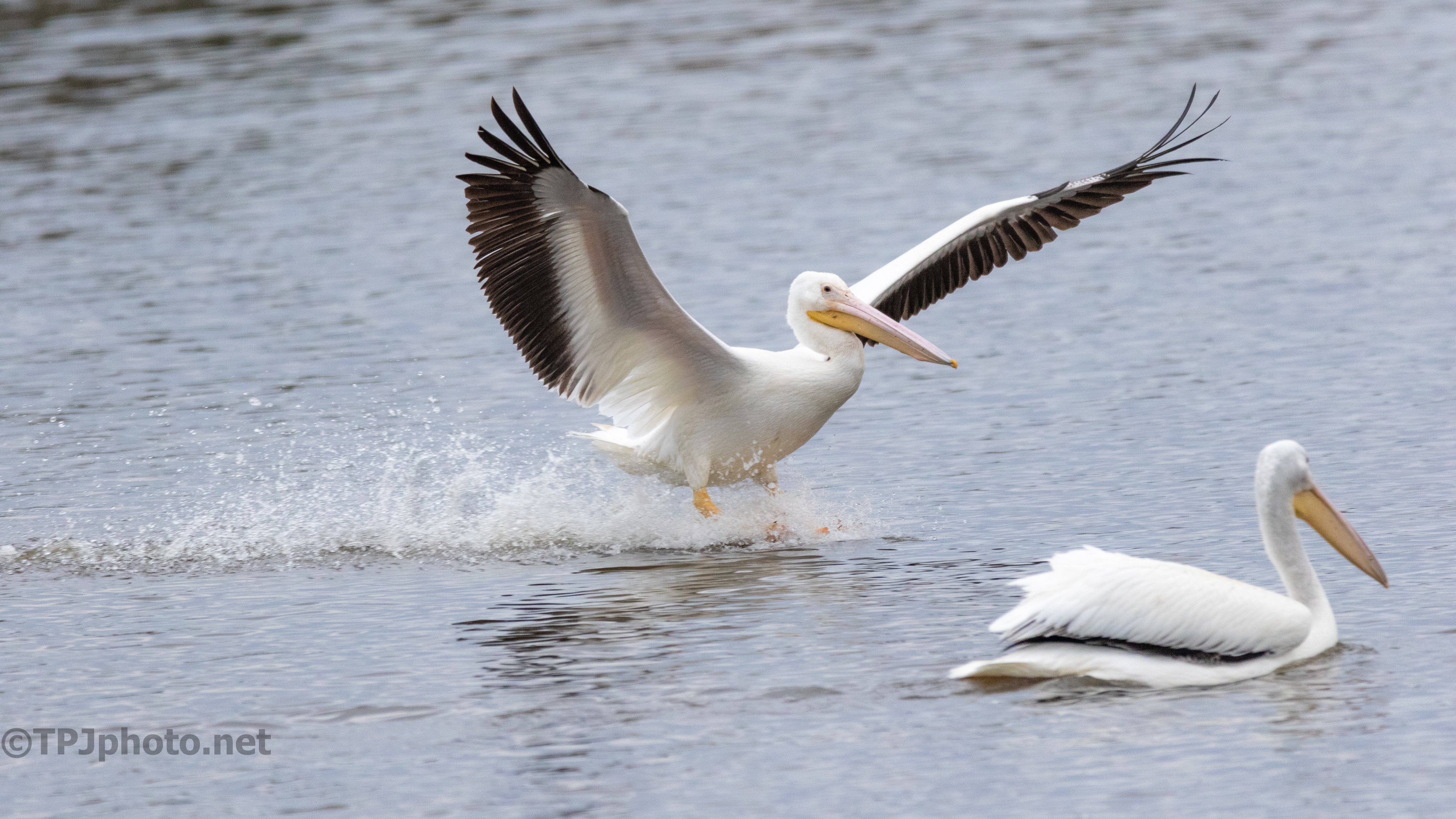
Based on their size you can see why landing takes a little room.
The most interesting photographs of White Pelicans is when they land.
Click, or double tap, any image below to view the gallery.
Sliding Into The Group, Pelican – click to enlarge
Sliding Into The Group, Pelican – click to enlarge
Sliding Into The Group, Pelican – click to enlarge
Sliding Into The Group, Pelican – click to enlarge
Sliding Into The Group, Pelican – click to enlarge